Which dashcams do the police use in Germany?
The police in Germany do not use off-the-shelf dashcams but permanently installed in-vehicle camera systems. Baden-Württemberg operates 107 systems with four Full-HD cameras each; Rhineland-Palatinate is fitting around 350 patrol cars with rear cameras from 2026. What matters is not image quality, but that every recording is admissible in court.
What is installed in patrol cars today
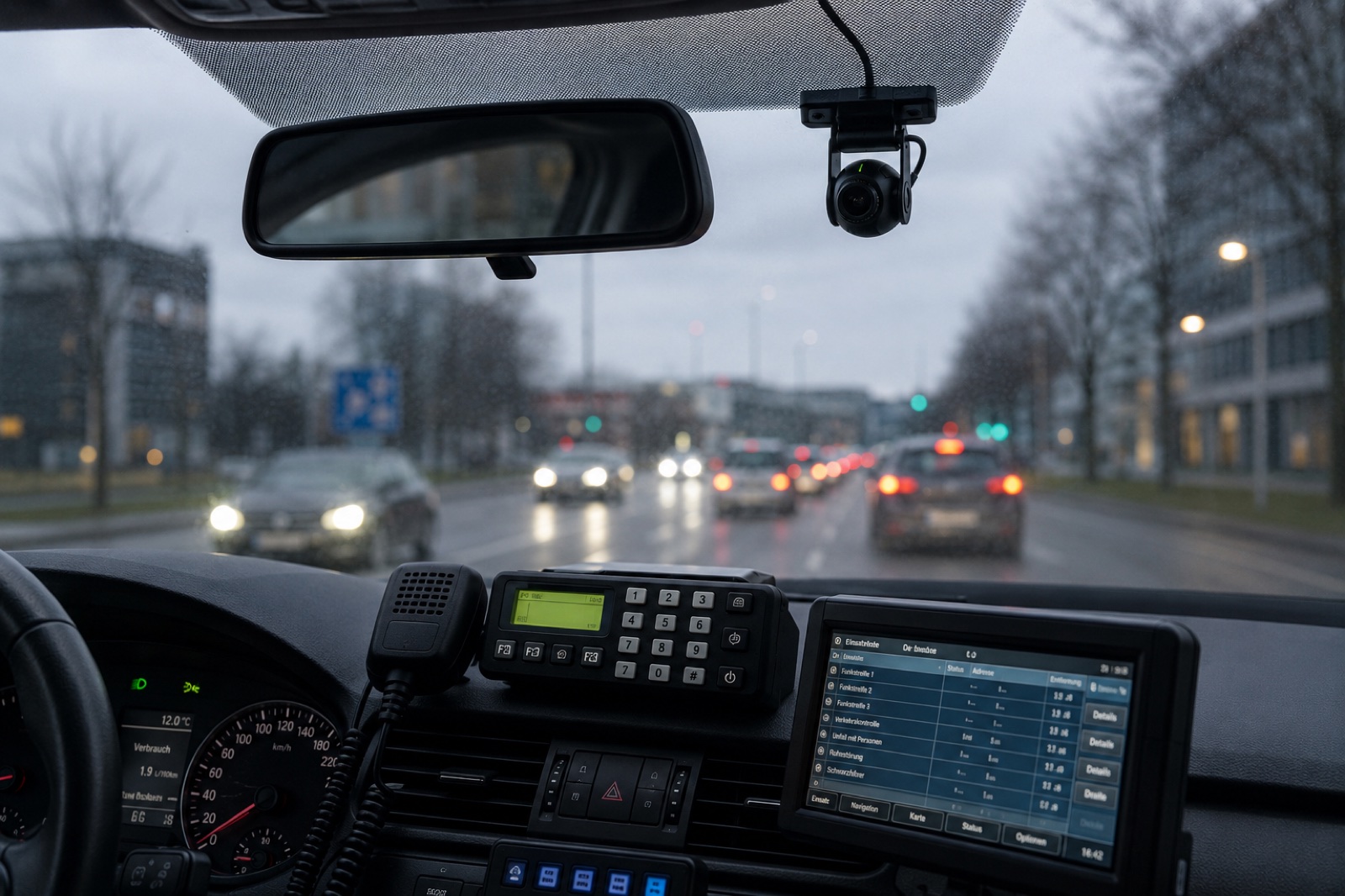
Search the web for "police dashcam" and you mostly get consumer buying guides. Inside a patrol car, things look different: permanently integrated multi-channel systems capture the entire surroundings of the emergency vehicle — not just the windscreen.
Baden-Württemberg operates 107 systems with four Full-HD cameras each for evidential documentation and is expanding the programme. The first year’s tally: 1,155 documented traffic offences, including 860 emergency-lane violations alone. Interior Minister Thomas Strobl calls the vehicle cameras “a valuable aid in the evidential documentation of complex traffic offences and emergency-lane violations”. (Source: Ministry of the Interior BW)
Rhineland-Palatinate is fitting around 350 new patrol cars with a rear camera for officer protection as standard — in service from 2026. (Source: Ministry of the Interior RLP, 16 May 2025)
Body-worn cameras are also part of the picture: the bodycam is now standard equipment in many places, but it only shows what the individual officer sees. The area around the vehicle — groups approaching, objects thrown from a distance, the violation in the emergency lane — stays outside its field of view. This is exactly the gap that vehicle-mounted systems close.
Why an ordinary dashcam is not enough for the police
A consumer dashcam records. That is enough for private drivers, not for public authorities. A police system has to meet four requirements that play no role in the electronics store:
Court admissibility. Every recording must be tamper-proof signed to stand up in proceedings. In 2018 the Federal Court of Justice ruled (Case No. VI ZR 233/17) that admissibility is decided by a balancing of interests — event-driven, signed recording is the methodically sound approach.
Data protection by design. Event-driven recording with a ring buffer instead of blanket surveillance: as little as possible, as much as necessary.
Chain of evidence. Position, time and device binding must attribute every recording beyond doubt — from the vehicle to the court.
Vehicle integration. CAN bus, covert installation, operation in all weather. A suction cup on the windscreen is not operational equipment.
Made in Germany: the Travido 625
The Travido 625 is a 4-channel recorder for emergency vehicles, developed and manufactured in Braunschweig — by a team that has been building mobile video technology for public authorities for over 25 years. Up to four Full-HD cameras capture the entire vehicle surroundings; every recording receives GNSS position and timestamp and is signed automatically and immutably, in line with BSI guidance (TR-02102-1).
The difference from proprietary systems: the authenticity of every recording can be verified by any independent party — court, expert witness, defence — using standard tools. An open procedure instead of a black box. The evidence stays entirely in German hands: no external backend, no access under foreign cloud laws.
Frequently asked questions
Do the police have dashcams in their cars?
Increasingly, yes. Baden-Württemberg operates 107 vehicle-mounted camera systems; Rhineland-Palatinate is fitting around 350 patrol cars with rear cameras from 2026. Other federal states are trialling similar systems.
Which camera do the police use in patrol cars?
Not an off-the-shelf dashcam, but permanently installed multi-channel systems with signed, court-admissible recordings — such as the Travido 625 with four Full-HD cameras, GNSS and automatic signing in line with BSI guidance.
Are recordings from police vehicles admissible in court?
Yes, provided they are tamper-proof signed and recorded on an event-driven basis. The Federal Court of Justice (Case No. VI ZR 233/17) clarified that admissibility is decided by a balancing of interests — signed recordings bound to the device meet the requirements by design.
May the police use my private dashcam footage?
Yes. Footage from private dashcams can be used as evidence; in serious cases the police may demand its release or seize the device. Anyone who has recorded an accident or violation can also hand the footage to the police themselves.
Video evidence for your fleet?
For procurement: documents, guide prices and the procedure document in the secure partner area.
To the partner area